Java’s a hot topic in the programming world, and no wonder. It’s like the Swiss Army knife of coding languages, versatile, powerful, and just a little bit fancy. Developers adore it, businesses rely on it, and even your grandma’s toaster probably has a sprinkling of Java in its software. So, what’s all the fuss? This article dives deep into the Java ecosystem, covers the basics, and highlights best practices. Prepare for a journey through the world of Java code that’s as enjoyable as finding a 20-dollar bill in your winter coat.
Understanding Java and Its Ecosystem
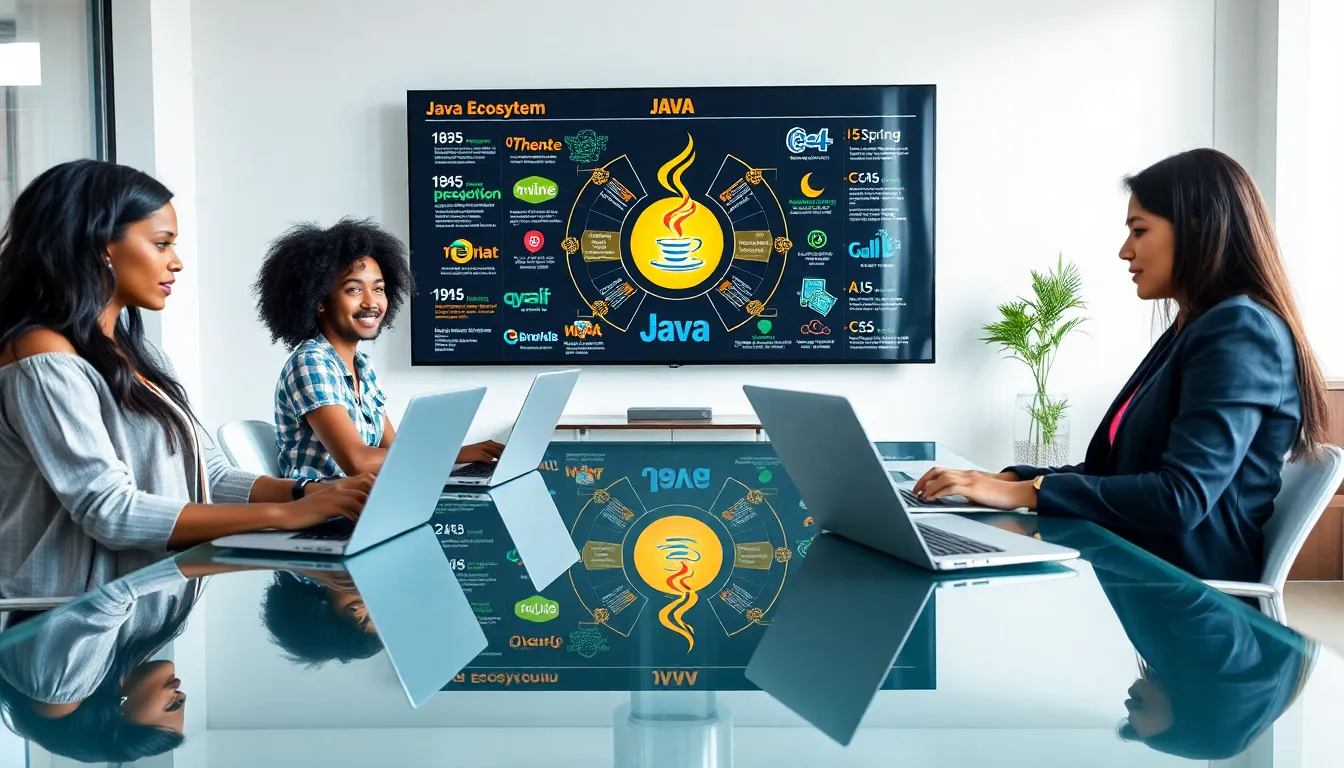
Java is more than just a programming language: it’s a comprehensive ecosystem that offers a robust platform for building applications. Originally developed by Sun Microsystems in the mid-1990s, it has grown to be one of the most widely-used programming languages, powering everything from enterprise software to mobile applications.
What makes Java truly shine is its portability. Write a program once, and it can run anywhere that has a Java Virtual Machine (JVM). This is often celebrated with the phrase, “Write once, run anywhere,” which encapsulates Java’s core philosophy. Also, Java boasts a massive developer community that contributes to its richness and continuous growth.
Beyond its fundamentals, the Java ecosystem comprises numerous libraries and frameworks that simplify development. Spring, Hibernate, and JavaFX are just a few examples, each designed to address specific programming challenges, eventually enhancing productivity. Whether a developer is focused on web applications, mobile development, or enterprise software, Java offers tools that make the job easier.
The Basics of Java Programming
Getting started with Java programming might seem daunting, but it really boils down to a few essential concepts.
Key Features of Java
Java is an object-oriented programming language, which means it emphasizes the use of objects and classes to organize code efficiently. This leads to modularity and reusability, two characteristics that are crucial in today’s fast-paced programming environment. Also, Java is platform-independent, strongly typed, and has automatic memory management through garbage collection.
Java Syntax and Structure
One of Java’s strengths lies in its readable syntax. Think of it as the clear signpost on a chaotic road. Its structure consists of a main class, and within this class, the main method initiates the program. Here’s a quick example:
public class HelloWorld {

public static void main(String[] args) {

System.out.println("Hello, World."):

}

}
This simple code snippet highlights how easy it is to print a message in Java. The semicolons, curly braces, and keywords may seem familiar if someone has programmed in C or C++, making the transition smoother.
Common Java Libraries and Frameworks
Java boasts an extensive collection of libraries and frameworks that accelerate development. Leveraging these tools can save time and keep the codebase clean and efficient.
Some notable mentions include:
- Spring Framework: Ideal for building web applications and microservices, Spring simplifies application development with its vast ecosystem.
- Hibernate: An object-relational mapping framework that eases database interactions, allowing developers to focus on the application logic.
- Apache Commons: A collection of reusable Java components that enhance standard Java libraries, making common tasks simpler.
Using these libraries is akin to using a toolbox: it provides specialized tools to address various challenges without reinventing the wheel.
Getting Started with Java Code
Jumping into Java programming can be exhilarating. If someone is eager to immerse, here’s a quick roadmap to get started.
Developing a Simple Java Application
Begin with a coding environment. A reliable Integrated Development Environment (IDE) like IntelliJ IDEA or Eclipse can tremendously ease the process. Once set up, creating a simple Java application means crafting a few lines of code, just like in our earlier example.
Compiling and Running Java Programs
Compiling Java code converts it into bytecode, which the JVM executes. This is where the magic of portability comes into play. To run a program, a developer simply uses commands like javac HelloWorld.java to compile and java HelloWorld to execute the program. Building a Java application suddenly feels like piecing together a puzzle, each step leads logically to the next.
Best Practices for Writing Java Code
Knowing how to write Java code is one thing: writing good Java code is another. Here are some best practices that seasoned developers advocate:
Common Pitfalls to Avoid
New developers often fall prey to misunderstandings around object-oriented principles, such as inheritance and encapsulation. Avoid tightly coupled code: it leads to maintenance nightmares down the road. Also, improper exception handling can cause unexpected behaviors or crashes in applications.
Optimizing Performance in Java Applications
Java offers tools for performance tuning. Use profiling tools to identify hotspots within the code that consume excessive resources. Carry out lazy loading for resource-intensive operations, and always prefer using built-in classes over reinventing solutions. These strategies enhance not only speed but also overall application efficiency.